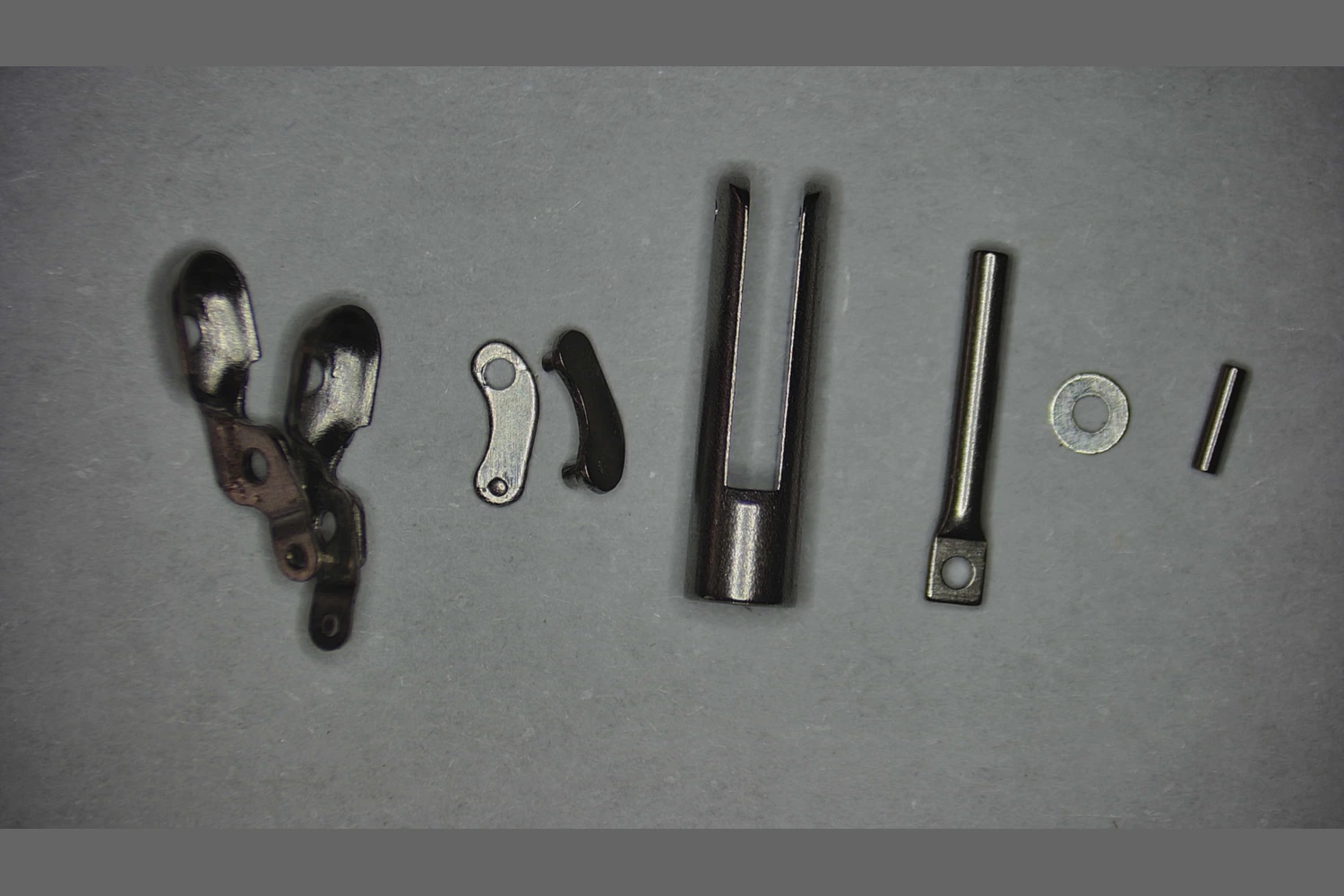
If you are already sourcing biopsy forceps jaws or related components through MIM or another powder-based process, it may be worth looking at progressive stamping as another supply route.
Not because stamping is automatically better.
But for parts that are suitable for forming and ordered repeatedly in volume, the cost structure can be very different.
Where Stamping Starts to Make Sense
MIM works well for many small, complex metal parts. At the same time, molding and sintering bring their own requirements for dimensional control.
With progressive stamping, more of the work is put into the tooling at the beginning.
Once the die has been developed, adjusted and brought into a stable production condition, the forming operations are built into the tooling and the parts can be produced continuously.
For an OEM buyer, that can mean:
- stable repeat production
- good capacity for ongoing orders
- consistent component geometry
- fewer separate forming operations
- a more competitive unit cost once volume is there
The last point is often what makes buyers take a closer look.
Tooling takes time and money upfront. But once the tooling is running steadily and the volume is sufficient, the cost per part can become lower and more predictable.
For a disposable-device program that keeps ordering the same component, that difference matters.
The Hard Part Is Getting the Tooling Stable
In our own production, the hard part is not making one good sample.
The hard part is getting the tooling into a condition where it can keep making the same part.
During development, punches, forming conditions and key dimensions may need to be checked, adjusted and tested several times. Once the required condition is reached and the tooling is maintained properly, production becomes much more straightforward.
That is the point where progressive stamping starts to show its real value.
The development work is done upfront. The benefit comes later, through repeat production.
Progressive stamping is the production route we use for our established biopsy forceps components and head assemblies.Selected head assemblies involve additional assembly steps, including laser welding where required.
For buyers, that means a more stable production process, easier planning for repeat orders and better control over long-term cost.
It also gives OEM customers more flexibility to choose whether they want individual components, coordinated component sets or a more complete head assembly.
What We Would Compare as a Buyer
If we were comparing an existing MIM supply route with a stamping-based alternative, we would not look at piece price alone.
We would also look at:
- how much volume is needed each year
- whether different batches stay consistent
- whether the supplier can scale production
- how much sorting or adjustment is needed later
- how the parts behave in downstream assembly
A low quotation is useful.
A low quotation that can still be repeated reliably over future orders is much more useful.
For suitable biopsy forceps components, progressive stamping can offer a good balance of price, repeatability and supply capacity.
Where PRECIBRIDGE Fits
PRECIBRIDGE focuses on small, complex precision metal components, including established biopsy forceps component families produced through precision stamping and tooling.
Depending on how much assembly you want to keep in-house, we can supply:
- individual components
- coordinated component sets
- selected head assemblies
If you already have an existing part, drawing or physical sample, you do not need to redesign the product before talking to us.
Send us what you are using now.
We can first look at whether the geometry is suitable for our stamping process, whether the expected volume makes sense for this route, and what level of supply fits your production.